|
Click the comments link on any
story to see comments or add your own.
Subscribe to this blog

RSS feed
|
Home
25 Jun 2012
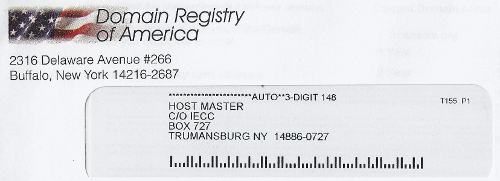 An ICANN-accredited registrar known variously as Domain
Registry of America, Domain Registry of Canada, and Brandon
James Internet is famous for sending out fake domain renewal
notices. They are physically located west of Toronto, not
far from the US border. Despite being sanctioned by both
the Federal Trade Commission
in the US and the
Competition
Bureau in Canada, they made minor adjustments to the notices, and in the latter case,
changed their name, and kept at it.
An ICANN-accredited registrar known variously as Domain
Registry of America, Domain Registry of Canada, and Brandon
James Internet is famous for sending out fake domain renewal
notices. They are physically located west of Toronto, not
far from the US border. Despite being sanctioned by both
the Federal Trade Commission
in the US and the
Competition
Bureau in Canada, they made minor adjustments to the notices, and in the latter case,
changed their name, and kept at it.
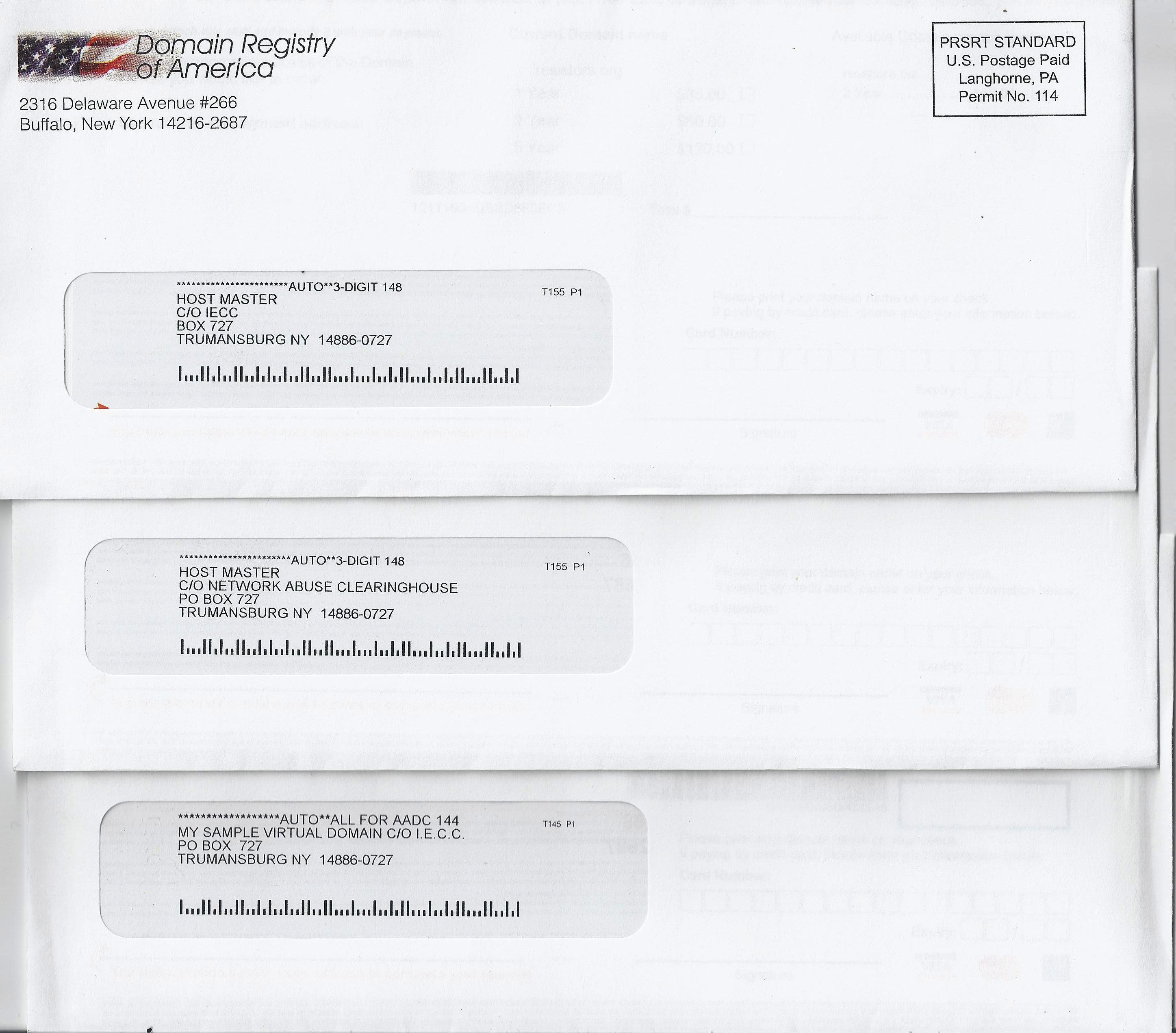
Someone asked whether they're still sending out fake domain notices.
Oh, yes, I have a stack of them about 10cm (that's four inches in the US)
high. Click on the image to see the three that arrived in today's mail.
I have long said that something is deeply broken in ICANN's registration
accreditation agreement and compliance process if they permit these
scammers to continue for a decade under ICANN's nose.
That hasn't changed either.
Stable link is https://jl.ly/ICANN/droa.html
 It's coming up on the date when I'll pay back my first $10K loan of free
money, so what did my pals at Capital One do? Send me a stern note saying
I'm misusing the checks? Cut my credit limit? Heck, no, they sent me a
little booklet with more no-fee checks so I can keep going at least
through March.
It's coming up on the date when I'll pay back my first $10K loan of free
money, so what did my pals at Capital One do? Send me a stern note saying
I'm misusing the checks? Cut my credit limit? Heck, no, they sent me a
little booklet with more no-fee checks so I can keep going at least
through March.
Someone noted that I am not their target demographic. I guess not.
Perhaps I should call up and ask for a larger credit line, anyway.
Stable link is https://jl.ly/Money/freexmas.html
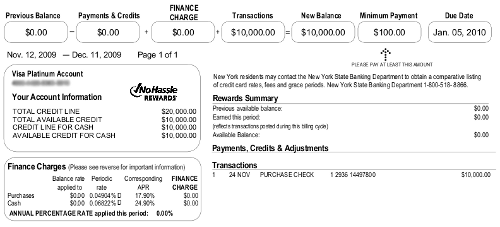 A few weeks ago
I blogged about some credit card
checks that Capital One sent, with terms that appeared to offer free
money.
I wrote myself a check for ten grand, and deposited it in the bank to
see what would happen.
A few weeks ago
I blogged about some credit card
checks that Capital One sent, with terms that appeared to offer free
money.
I wrote myself a check for ten grand, and deposited it in the bank to
see what would happen.
See more ...
Stable link is https://jl.ly/Money/capone3.html
While flipping through the pile of advertising flyers that arrived with today's
paper, I came across this one:
See more ...
Stable link is https://jl.ly/Internet/zagatwine.html
You knew this was going to happen, but I bet you didn't expect
it quite so soon:
See more ...
Stable link is https://jl.ly/Internet/nomorev4.html
22 Jun 2012
In recent months there's been a robust and apparently well-funded debate
about the legal status of search engine results, in particular Google's
search results.
On Tuesday, Tim Wu, a well-known law professor at Columbia weighed in with
an
op-ed in the New York Times, arguing that it's silly to claim that computer software
has free speech rights.
Back in April, equally famous UCLA professor Eugene Volokh published
a paper,
funded by Google, that came to the opposite conclusion, that in some cases they do.
(Personally, I think they do to the extent the results reflect the intentions
of the humans who wrote the code.)
The reason this is a hot topic, of course, is because some people whose
web sites don't appear as high as they'd like in search results think
it's a monopolistic plot against them, and Google should be required
to present search results in a neutral way. It might be, but more likely it's not,
and the cure would be far worse than the problem.
See more ...
Stable link is https://jl.ly/Internet/searchneut.html
16 Jun 2012
Last summer I did an eight part series
on the design of the DNS.
Since people still seem to be interested in it, I collected them
into a white paper
that you can more easily archive and print.
Stable link is https://jl.ly/Internet/designwp.html
13 Jun 2012
ICANN unveiled
all the applications for new top level domains today, all 1,930 of them.
Most of them were fairly predictable, big companies applying for their own names like .IBM,
.DUPONT, .AUDI, and .HSBC.
The most applications for the same name were 13 for .APP, 11 for .INC and .HOME,
10 for .ART, 9 for .SHOP, .LLC, .BOOK, and .BLOG.
None of those claim community support so they'll have to slug it out in the
contention process.
See more ...
Stable link is https://jl.ly/ICANN/lotsa.html
07 Jun 2012
Although I'm sceptical that IPv6 will have any practical use in e-mail in the forseeable future,
it makes plenty of sense for web sites.
The web browsers on mobile phones are likely to have direct v6 connections,
but NAT or proxies for IPv4, so web sites can work better if they're
available on IPv6. Since it makes no difference at all for mail, my
advice is to work on v6 for your web sites and forget it for mail.
(If you run a large ISP, IPv6 makes sense for internal POP, IMAP,
and SUBMIT
servers, but if you run a large ISP, you already knew that.)
Taking my own advice, this blog has been available via IPv6 for
the better part of a year. Did anyone notice?
Stable link is https://jl.ly/Internet/ipv6.html
|
Topics
My other sites
Who is this guy?
Airline ticket info
Taughannock Networks
Other blogs
CAUCE
It turns out you don’t need a license to hunt for spam.
33 days ago
A keen grasp of the obvious
Italian Apple Cake
591 days ago
Related sites
Coalition Against Unsolicited Commercial E-mail
Network Abuse Clearinghouse
My
Mastodon feed
|